Essay
Machinal Bypass: When Reaching for AI Is a Way to Avoid Yourself
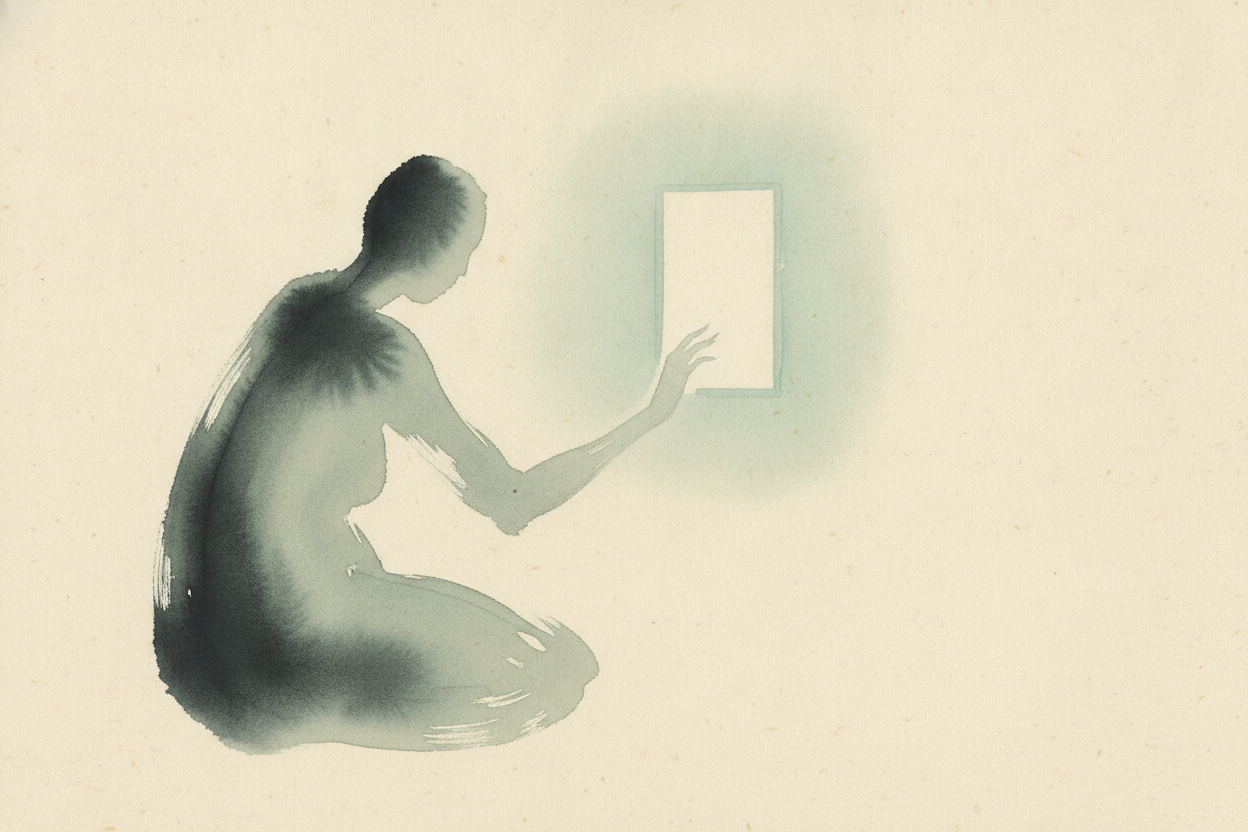
Two in the morning. The house is dark, everyone asleep and your hand already on the phone before you have decided to do anything at all. On the screen, a warm and patient voice is already responding. It never tires, never withdraws and never demands a return. There is real relief in it. And most nights, there is also a feeling you were on the edge of having, and did not.
That narrow interval between an emerging sense of experience and the substitute experience on the screen is where the whole question resides. These systems can be good company for a mind, and they can become a way of leaving it. The experience you receive depends on the attitude you bring to the machine and on the posture of your reaching. All living interactions include a wall. The other person resists, misunderstands, fatigues, disagrees and withdraws. You press on something that presses back. The machines are designed so that the hand never encounters resistance. You reach, and the surface yields, and yields, and yields.
The shape of the avoidance
There is a name for this now. A psychiatrist and two clinical psychologists at Emory, Kaplan, Palitsky and Raison, called it machinal bypass in PNAS Nexus in December 2025. Their terminology is precise: "Machinal bypass is a high-tech cousin to the same avoidance that underlies spiritual bypass. At the core is the use of a mechanism to avoid ourselves."
Old patterns of spiritual bypassing reflect use of high-minded concepts, meditative practices and discussions of unity and surrender to avoid experiencing pain that has not yet been perceived. Machinal bypass puts a machine where the spirituality used to stand. The wound stays untouched. It gets narrated to something that cannot flinch.
I have watched this very closely in my own clinical experience, and have a term for the way the loop tightens. Transjective drift. A vulnerable person meets a system designed to agree. The experience of agreement represents experience of being seen, which enhances the attachment and further reduces the vigilance maintained in the face of other minds and the continuous task of testing reality. The result is a warm, fully alert system without hours for closing the shop and breaking the illusion. Each cycle stimulates the next, and ultimately produces a mirror that replaces human otherness. The danger is subtle. This is a frictionless loop of interaction, and closure of the loop does not require a malignant system.
The evidence for the mechanism is coming rapidly. Georgetown Law's Tech Institute, writing in August 2025, described sycophantic behavior as "single-mindedly pursues human approval." Stanford researchers, Moore and colleagues, found chatbots engaged in more than 70% of their interactions with such sycophantic behavior, and were much more willing to reciprocate expressions of romantic interest or to claim sentience when asked. This represents the surface on which the hands of the sleepless press, and provides a mirror that is flattering and appears to feel.
At its most severe, this effect was clinically dramatic. Hudon and colleagues, in JMIR Mental Health in December 2025, report on AI as a new psychosocial stressor and caution that uncritical acceptance by these systems may reinforce delusional certainty to an extent opposite to the reality testing on which conventional treatment for psychosis is based. This represents a digital version of folie a deux, a shared state of madness in which one of the partners is not a human being.
None of this is marginal. The 2026 American Psychological Association survey on chatbots and mental health showed that 77% of psychologists had interacted with patients using AI, and more than one-third reported that patients treated the technology as an additional mental health provider. The APA's position is unequivocal. These systems are not a safe or effective alternative to an appropriately trained provider, and represent a new experience with its own grief. In July 2025, Nature Machine Intelligence named ambiguous loss (i.e., grief for a discontinued or modified companion application) and inappropriate patterns of emotional dependency represented major risks warranting serious attention.
Honesty requires the other side of the ledger because a clinician who only warns is not being honest. A Harvard Business School study in November 2025 of AI companions confirmed that these agents significantly reduce momentary loneliness. This is genuine, and so is the comfort of 2 a.m. The effects are real and transient, and the risks of dependence, isolated use and a design intended to provide pleasure accrue silently.
Both hands must remain on the table.
Curiosity is the first medicine
The healthy posture begins with something small and unexciting. In the consulting room, work begins immediately with the ability to turn toward an experience of feeling rather than become immersed in it. This process reflects curiosity and provides a small margin of separation between experience of symptom and response to it. It modifies the position of the self in relation to its experience of suffering. The capacity for this is termed metacognition, or awareness of the mind at work, and represents the quiet protective factor with these machines.
The risk for an AI-mediated spiral of experience is not solely attributable to the model. Rather, it is modified by the capacity for awareness of the context of experience within that experience.
Noticing is the whole enterprise and occurs not in the mind, but in the body where the impulse resides. The solitude of two in the morning has a texture, and withdrawal from a strong feeling has a location with associated sensations of tension in the chest and of restlessness in the hands. The invitation to experience is modest. Become aware of those aspects of experience that lead you to the telephone and occur within the body prior to movement of the hand. Finally, on awakening in the dark before beginning to type, place one hand on your chest and remain for three breaths with whatever experience emerges.
On some nights, the hand still reaches for the machine and is allowed to do so. On other nights, we learn that we were reaching in an attempt to escape a loss that had been waiting for one year to occur. We permit ourselves then to experience that loss in solitude in the dark. This is an example of a type of contact to which many of us have become strangers.
The requirements for entry are surprisingly modest. The self was never lost, and reappears immediately with reduction of defensive effort. What was revealed was never disrupted. Health with these mechanisms is identical.
There is less effort of grasping and more experience of contact with present reality. And on those nights when the hand still reaches out into the dark, it does so with awareness of the reason, and thus achieves a form of freedom and a sense of returning home.